
 How much of your mental energy is spent at present thinking or worrying about the future?
How well is that serving you?
And what does this have to do with breathing?
As this strange, dark and unsettling DC world continues, there is much potential for anxiety about how long lockdown will last. Fears are being expressed too about how lockdown will be gradually lifted, the implications of that and the reality of living with some level of social distancing for much longer than any of us could have ever imagined BC.
Last week I was musing about the importance of giving grace to yourself and to others. You can read more on that here, as taking time to notice the feelings that lie underneath negative behaviour is important as tension mounts and tempers can start to fray.
Yesterday I shared this quote, from a wee daily devotional book:
Most of the situations that entangle your mind are not today’s concerns; you have borrowed them from tomorrow.”
This was reflecting the words of Someone very wise who talked about not worrying about tomorrow because it has enough worries of it’s own (Jesus, in Matthew’s Gospel Chapter 6 verse 34)
But if we are honest, in this current season, how much mental energy is spent worrying about things over which we have no control? The implications and ramifications of measures taken to control Covid-19 are indeed going to be long lasting and hugely challenging. That is true. However, I know that much of what I am tempted to worry about is far beyond any ability I might have to fix, repair, restore or control.
And the end result is that I exhaust myself with fears and deny the potential I do have to control what I can.
What thoughts are filling your head today, and what direction are those thoughts taking you in – towards peace or away? Towards the best version of yourself or away? If you are a person of faith, towards God or away?
There is a simple process here that can help us recognise when we need to become grounded again, and this is where breathing comes in.
First step: recognise the triggers.
For me, irritation is key. When I am leaking irritation, it is usually because I feel out of control. And lack of control is a symptom of much deeper fear. Notice what triggers your key fears and what brings your attention to the fact that your thoughts are filled with fears about the future.
Next, identify what the common thoughts are.
Then look objectively at how much of that you can control. If there is action you can take, take it in small stages. If there is nothing you can do, recognise the damage that is being done emotionally by following these thoughts.
Thirdly, choose instead to come back to THIS moment.
Notice what is happening around you. The best tool for this is deep breathing. I used to work as a physiotherapist (physical therapist; more about me here if you are really interested!) and I have spent much time teaching people deep breathing and relaxation. Plenty of science abounds as to the physiological benefits of deep diaphragmatic breathing, and it is a key element of mindfulness.
I have recently finished reading Brene Brown’s astoundingly powerful book Rising Strong. If you have time and want some serious internal rearranging and a source of profound hope for our own character growth, read this book.
Her description of square breathing is the one I have started using. Breathing round a square is a simple way of visualising what you are doing, which for some is an important part of this. Visualisation is helpful because it takes further concentration and takes us out of that negative thinking loop.
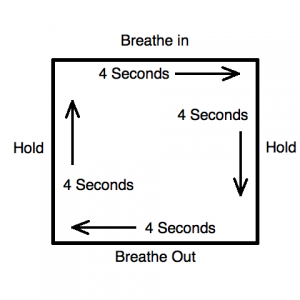
Fourthly, practice deep breathing:
- breathe in through your nose for four counts – breathing deeply from your stomach
- hold for four
- breathe out of your mouth for four
- hold for four.
What I found profound from Brene Brown’s book is her quote about mindfulness, from the Greater Good Science Centre at the University of California, Berkeley
Mindfulness means maintaining a moment-by-moment awareness of our thoughts, feelings, bodily sensations, and surrounding environment. Mindfulness also involves acceptance, meaning that we pay attention to our thoughts and feelings without judging them—without believing, for instance, that there’s a “right” or “wrong” way to think or feel in a given moment. When we practice mindfulness, our thoughts tune in to what we’re sensing in the present moment rather than rehashing the past or imagining the future.”
And this takes us right back to where we started: rather than imagining the future, we become grounded in TODAY. What I CAN do today. What I am grateful for TODAY. What I HAVE today rather than what I fear I won’t have tomorrow.
So this week, in moments of anxiety and fear that take your thoughts spiraling away in the wrong direction, STOP, notice the triggers and practice square breathing to bring you back to NOW.
That is enough.
Want these blog musings straight to your inbox each week? Sign up HERE for that, and so much more!
[…] week I was musing here about the importance of being grounded in the moment, and using square breathing as a tool for that […]